

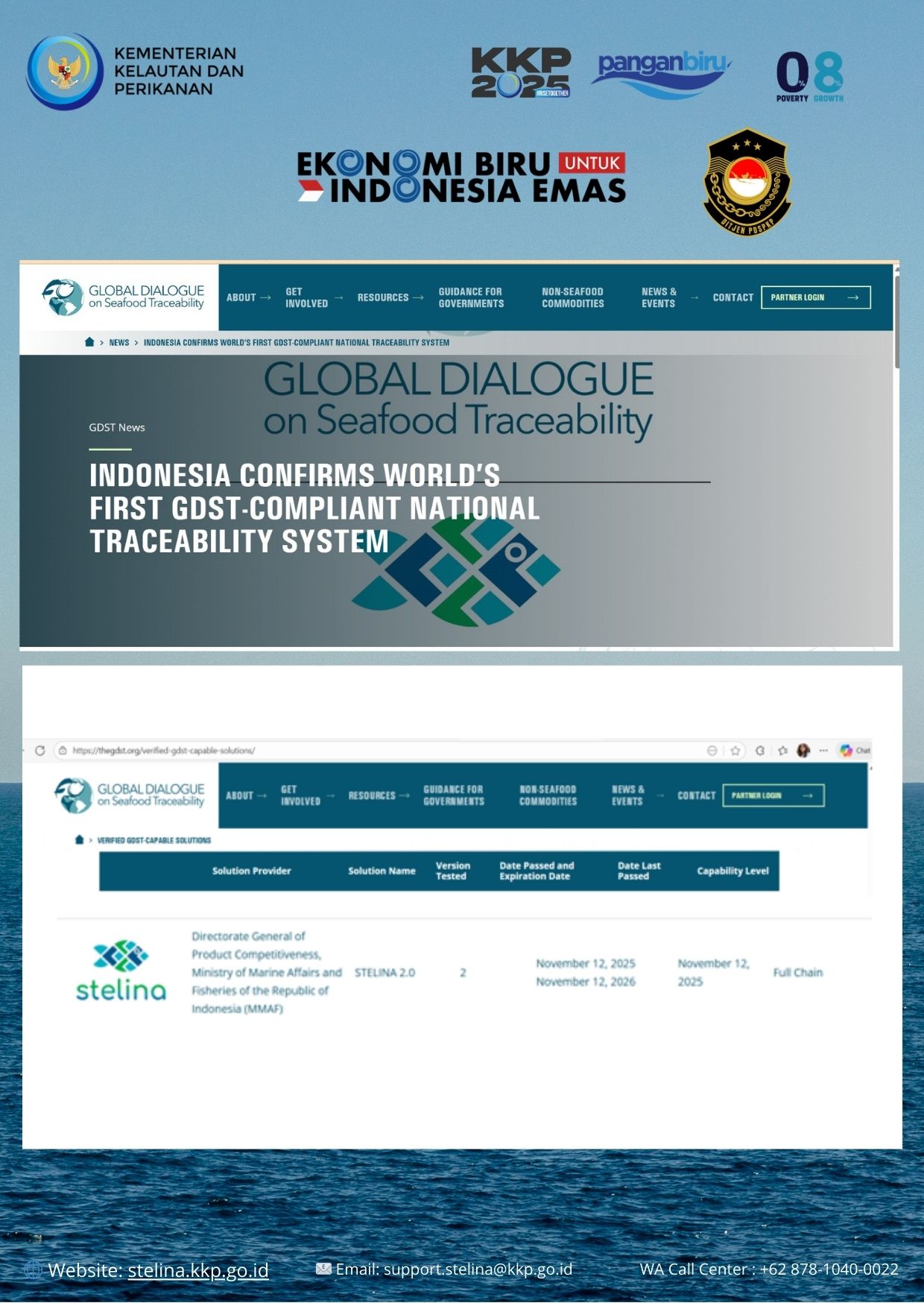
Indonesia has today announced a new milestone in its progress towards full traceability across its seafood industries. The country’s national seafood traceability system – STELINA (Sistem Ketertelusuran dan Logistik Ikan Nasional) – is now fully compatible with the Global Dialogue on Seafood Traceability (GDST) Standard, marking the first time a government-operated system anywhere in the world has accomplished this milestone. The achievement was announced today by the Ministry of Marine Affairs and Fisheries (MMAF) of the Republic of Indonesia, cementing the nation’s place as a world-leader in seafood traceability.
STELINA tracks seafood throughout its journey – from fishing boats and aquaculture facilities to the final market – by capturing information about how and where it has been caught or farmed alongside essential data on processing, handling, and legality. The system has now formally passed the GDST Capability Test, which evaluates a software provider’s ability to send and receive key data in the right format, allowing it to interact with other GDST-compliant traceability systems around the world. This ‘digital interoperability’ enables data sharing between trading partners using different systems – crucial for combating illegal practices, verifying sustainability claims, and meeting the demands of global markets.
The achievement by MMAF, who developed STELINA with full support from the Center for Data and Information (Pusdatin), is the culmination of 4 months of hard work, following the government’s announcement of its intention to become the world’s first nation to align a government-led system with international standards earlier this year. It marks a major step in supporting the country’s sustainable fisheries and aquaculture management and export competitiveness, reducing complexity and improving efficiency throughout the supply chain.
“Passing the GDST capability test is a landmark for Indonesia’s digital transformation in fisheries and aquaculture management,” said Machmud, Acting Director General of Product Competitiveness, MMAF. “STELINA’s compliance with international standards shows that Indonesia is not only serious about sustainable seafood but also about ensuring trust, traceability, and transparency from the source to the global market.”
“Our technical team worked intensively to align STELINA’s data systems with GDST standards,” said Aulia Riza Farhan, Head of the Center for Data and Information, MMAF. “This certification validates our system design and strengthens Indonesia’s digital infrastructure for seafood traceability.”
The capability testing process was conducted in partnership with the Institute of Food Technologists (IFT), whose Global Food Traceability Center provided technical support and validation.
AUTHOR: Anthony Floreno

Gedung Mina Bahari III Lantai 12
Jl. Medan Merdeka Timur No.16 Jakarta Pusat
Telp. (021) 3500163 , Fax. (021) 3500163
Email: stelina@kkp.go.id
Copyrights © 2025. STELINA KKP. All Rights Reserved.
